👨🔬 LPI: Dr. Diana Salim Maddah
This project focuses on strengthening the capacity of humanitarian organizations in Qatar to use artificial
intelligence (AI) in a responsible, practical, and impactful way. It responds to the growing need for
evidence-based and context-specific approaches to AI adoption in high-stakes humanitarian environments.
The project generated a comprehensive evidence base through two large scoping reviews, mapping both the
ethical principles and real-world applications of AI in humanitarian settings. Findings highlighted a clear
gap between high-level ethical guidance and its practical implementation, as well as uneven adoption of AI
tools across different contexts.
To understand readiness in Qatar, the project conducted a national survey and in-depth interviews with
humanitarian stakeholders. Results showed strong interest in AI, particularly for data management, needs
assessment, and monitoring, but also revealed key challenges, including limited technical capacity,
governance gaps, and concerns around data privacy and trust.
A key output of the project is the development of practical ethical guidance, designed to support
organizations in implementing AI responsibly across real-world humanitarian operations. This guidance helps
bridge the gap between global frameworks and on-the-ground application.
The project also established a national Technical Working Group (TWG) chaired by the Ministry of Foreign
Affairs and co-led by Qatar Funds for Development, bringing together stakeholders from government, academia,
and international organizations to co-design solutions and guide AI adoption in alignment with national
priorities.
In addition, the project led to the creation of the Humanitarian AI Observatory, an online platform that
curates policies, case studies, and tools to support knowledge-sharing and capacity building. The
Observatory serves as a central hub for advancing evidence-based and ethical AI use in the region.
Overall, the project provides a foundation for responsible AI adoption by translating research into
practical guidance, identifying priority use cases, and contributing to the development of national
strategies and capacity-building initiatives. It positions Qatar as an emerging leader in advancing ethical
and evidence-based AI in humanitarian action.
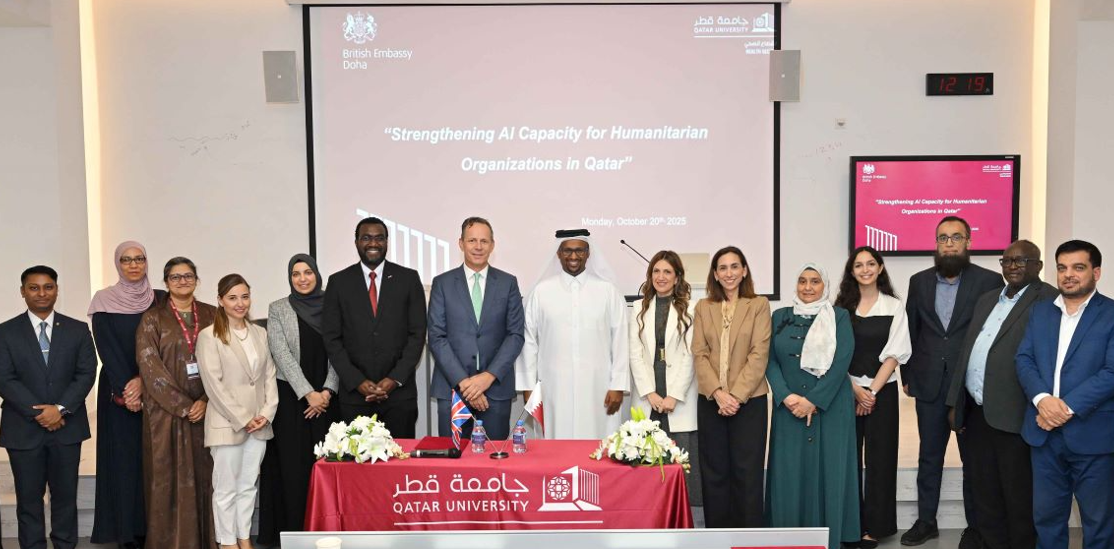
Figure: Strengthening AI in the Humanitarian Sector in Qatar.